
PCD vs ND vs TC Wire Drawing Dies | Complete Selection Guide
Compare PCD, Natural Diamond (ND) and Tungsten Carbide (TC) wire drawing dies. Learn which die is best for copper, aluminum and steel wire drawing applications.
PCD, ND & TC Wire Drawing Dies Comparison
Which Drawing Die Is Best for Your Application?
The wire drawing die used in the wire drawing process has a direct impact on production quality, drawing force, energy consumption, wire surface quality and tool life. Selecting the right drawing die not only reduces production costs but can also help prevent wire breaks and improve overall production efficiency.
Today, three main types of wire drawing dies are widely used in the wire and cable industry:
- Tungsten Carbide (TC) Dies
- Polycrystalline Diamond (PCD) Dies
- Natural Diamond (ND) Dies
Each die type is designed for different wire diameters, production speeds and materials. Therefore, there is no single die type that provides the best solution for every wire drawing application.
In this technical guide, we compare PCD, ND and TC wire drawing dies in terms of applications, advantages, limitations, cost, service life and performance. We also explain which type of drawing die should be considered for different wire drawing applications.
What Will You Find in This Guide?
✔ What is a wire drawing die?
✔ How does a wire drawing die work?
✔ What is a PCD drawing die?
✔ What is a Natural Diamond (ND) drawing die?
✔ What is a Tungsten Carbide (TC) drawing die?
✔ Technical comparison of PCD, ND and TC dies
✔ Which drawing die should be used for different wire diameters?
✔ Which drawing die is suitable for different wire materials?
✔ How to reduce wire drawing costs
✔ Frequently asked questions
What Is a Wire Drawing Die?
A wire drawing die is a high-precision tool used to reduce the diameter of metal wire through controlled plastic deformation.
Used in the production of copper, aluminum, steel and alloy wires, the drawing die directly influences wire diameter accuracy, surface quality, mechanical properties and overall production efficiency.
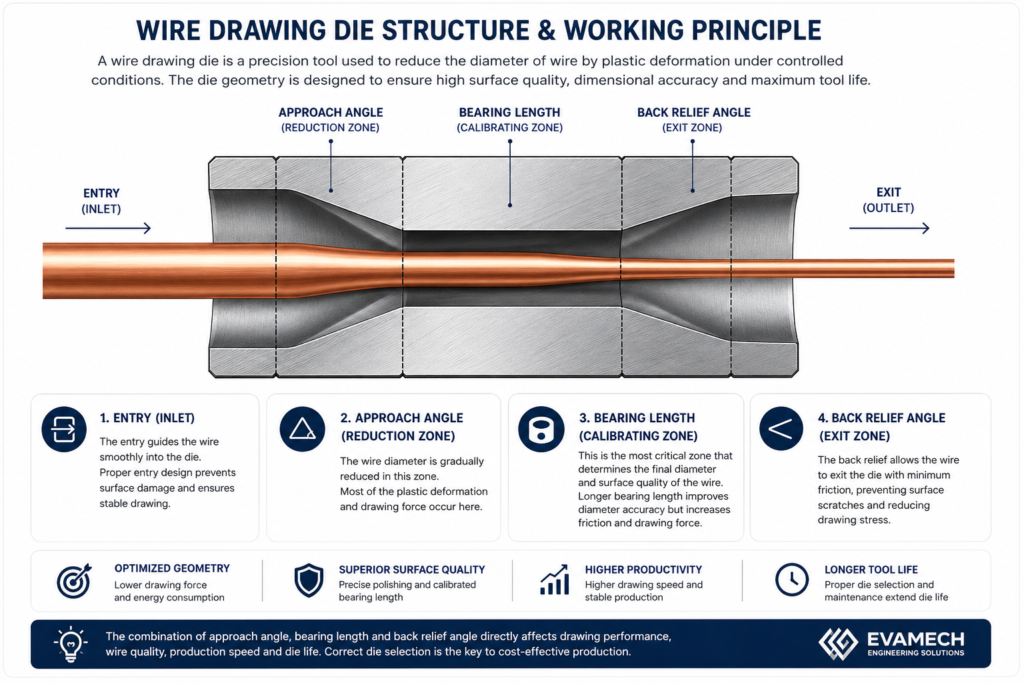
During the wire drawing process, the wire is pulled through the die while being progressively formed through the approach angle, bearing area and exit geometry.
Friction, drawing force and temperature generated during this process make proper die selection extremely important.
Selecting an unsuitable drawing die may result in:
- Wire breaks
- Higher energy consumption
- Poor wire surface quality
- Diameter variation
- Shorter die life
- Reduced production speed
For this reason, the correct drawing die should be selected according to wire diameter, material, drawing speed, reduction schedule and required surface quality.
How Does a Wire Drawing Die Work?
1. Entry Zone
Guides the wire smoothly into the drawing die.
2. Approach Angle
This is the primary deformation zone. The wire diameter is reduced through plastic deformation and the required drawing force is generated.
3. Bearing Area
The bearing is the critical section that determines the final wire diameter.
A longer bearing can improve dimensional stability, but may also increase friction and drawing force.
4. Back Relief / Exit Zone
Allows the wire to leave the die with minimum unnecessary contact and friction.
The geometry of these sections directly influences drawing performance, wire surface quality, dimensional accuracy and die life.
Technical Comparison: PCD vs ND vs TC Drawing Dies
| Feature | TC | PCD | ND |
|---|---|---|---|
| Typical Application | Larger wire diameters | General-purpose | Ultra-fine wire |
| Copper Wire | ⭐⭐⭐ | ⭐⭐⭐⭐⭐ | ⭐⭐⭐⭐⭐ |
| Aluminum Wire | ⭐⭐⭐⭐⭐ | ⭐⭐⭐⭐ | ⭐⭐ |
| Steel Wire | ⭐⭐⭐⭐ | ⭐⭐⭐⭐⭐ | ⭐ |
| Production Speed | ⭐⭐⭐ | ⭐⭐⭐⭐⭐ | ⭐⭐⭐⭐⭐ |
| Surface Quality | ⭐⭐⭐ | ⭐⭐⭐⭐ | ⭐⭐⭐⭐⭐ |
| Die Life | ⭐⭐⭐ | ⭐⭐⭐⭐⭐ | ⭐⭐⭐⭐⭐ |
| Friction | Medium | Low | Very Low |
| Reconditioning | ✔ | ✔ | ✔ |
| Relative Cost | Low | Medium | High |
Which Wire Drawing Die Should I Use?
Natural Diamond (ND) Dies
High-performance drawing dies developed particularly for ultra-fine copper wire applications.
✔ Excellent wear resistance
✔ Very long die life
✔ Extremely low friction
✔ Fine and ultra-fine copper wire production
✔ Superior wire surface quality
PCD Drawing Dies
One of the most widely used professional drawing die solutions in the global wire and cable industry.
✔ General-purpose applications
✔ Copper wire drawing
✔ Steel wire drawing
✔ Aluminum wire drawing
✔ Long service life
✔ Low total cost of ownership
Tungsten Carbide (TC) Dies
A durable and economical solution particularly suitable for larger wire diameters and applications where mechanical robustness is important.
✔ Larger wire diameters
✔ Aluminum applications
✔ Low initial investment
✔ Easy reconditioning
✔ Economical operation
Wire Drawing Die Selection Guide
| Production Application | Recommended Die |
|---|---|
| Copper wire 8 mm → 1 mm | PCD |
| Copper wire 1 mm → 0.5 mm | PCD |
| Copper wire below 0.50 mm | ND |
| Aluminum wire | TC or PCD |
| Steel wire | TC or PCD |
| High-speed production | PCD |
| Ultra-fine wire | ND |
| Cost-sensitive production | TC |
Consequences of Incorrect Drawing Die Selection
❌ Wire breaks
❌ Higher energy consumption
❌ Reduced production speed
❌ Shorter tool life
❌ Wire diameter variation
❌ Surface defects
PCD Drawing Dies
PCD (Polycrystalline Diamond) wire drawing dies are among the most widely used professional drawing dies for copper and aluminum wire production.
Their low friction characteristics enable high drawing speeds while providing excellent wear resistance and long service life. They are particularly suitable for manufacturers requiring reliable performance across medium and fine wire diameters.
PCD dies can also be repolished and reconditioned, helping reduce the total cost of ownership over their service life.
Ideal applications: Copper wire production, general-purpose wire drawing and high-speed production.
Natural Diamond (ND) Drawing Dies
Natural Diamond (ND) wire drawing dies are high-performance dies particularly suited to the production of very fine and ultra-fine copper wires.
The extremely low friction characteristics and excellent surface properties of natural diamond help achieve superior wire surface finish while maintaining high dimensional accuracy.
These characteristics make ND dies particularly valuable for high-precision applications such as electronics, communication cables, enamelled wire and micro-wire production.
With proper application and maintenance, ND drawing dies can provide excellent surface quality, long service life and highly stable performance in critical wire drawing processes.
Ideal applications: Ultra-fine copper wire, enamelled wire, electronics and communication cable applications.
Tungsten Carbide (TC) Drawing Dies
Tungsten Carbide (TC) wire drawing dies are widely used for larger wire diameters due to their mechanical strength, durability and economical cost.
Their robust structure provides reliable performance in copper, aluminum and steel wire drawing applications.
TC dies have been used for decades in larger-diameter wire production and can generally be reconditioned when required, helping manufacturers maintain relatively low tooling costs.
Although TC dies may not provide the same performance as PCD or ND dies in ultra-fine or extremely high-speed applications, their durability, cost efficiency and broad application range make them an important solution for the wire and cable industry.
Ideal applications: Larger-diameter copper, aluminum and steel wire drawing; economical and mechanically demanding applications.
Let Us Select the Right Wire Drawing Die Together
Selecting the wrong wire drawing die can result in higher energy consumption, shorter tool life, wire breaks and production losses.
At Evamech Engineering, we provide technical support to help manufacturers select the most suitable PCD, ND or TC wire drawing die for their specific production requirements.
Whether you are installing a new production line or optimizing an existing wire drawing process, we can evaluate your wire diameter, material, production speed and process requirements to help determine the most appropriate solution.